Overview
Physics has always fascinated me, especially when it comes to describing the world around us through mathematical formulas. Recently, I came across a concept that piqued my curiosity: the jerk, the derivative of acceleration. This post dives into the derivatives of motion and their significance in various contexts, while also touching on my personal experience of reconnecting with physics during my university years. 🧑🔬📚
Introduction
I’ve always found joy in understanding how we can use mathematical formulas to describe real-world phenomena, and my recent academic experience allowed me to rediscover this passion. One such moment of rediscovery was learning about the lesser-known derivatives of motion beyond acceleration, such as jerk. ✨📖
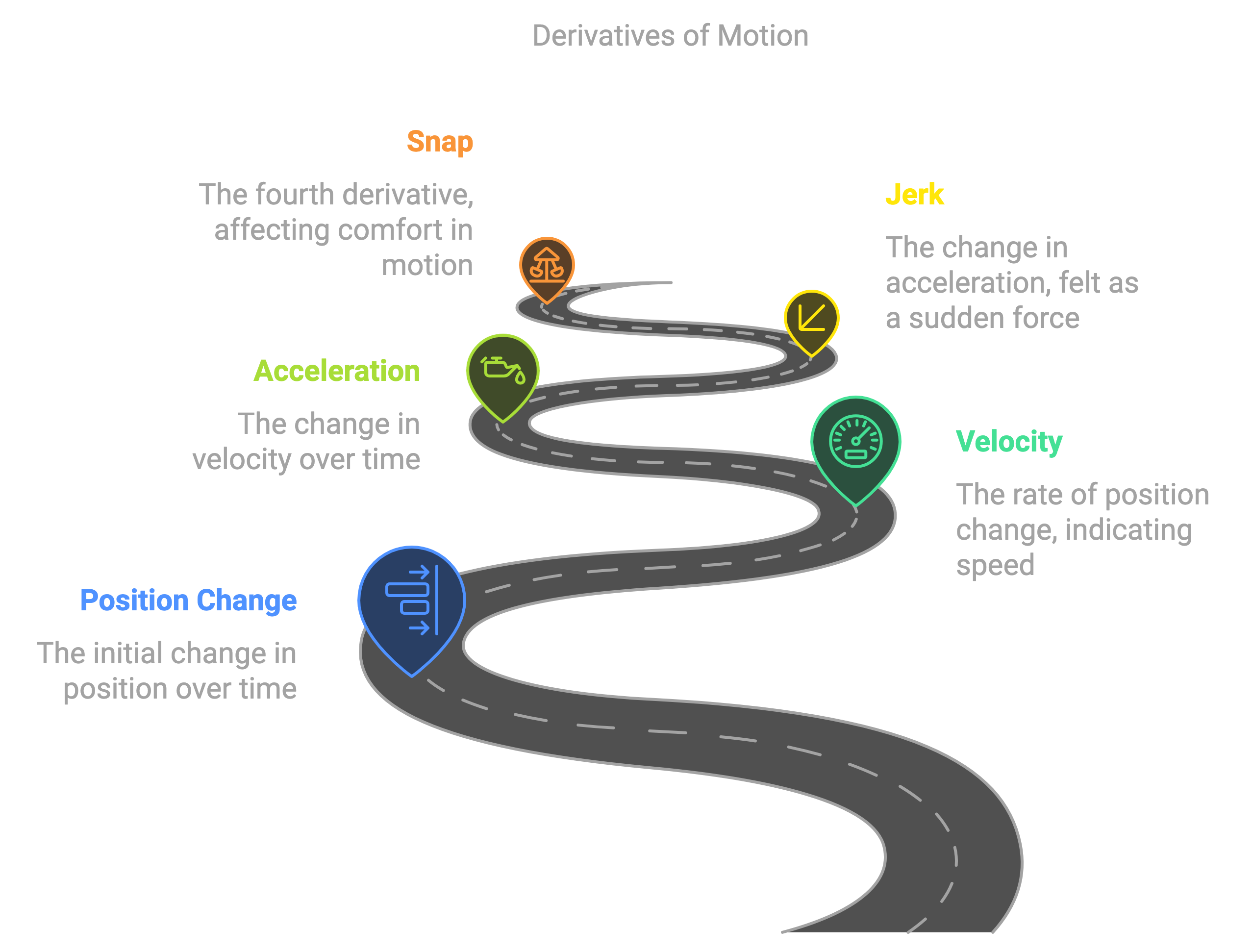
In the same way that velocity is the derivative of position, acceleration is the derivative of velocity. But what happens when acceleration changes? We get jerk—the third derivative of position with respect to time. This may sound like a dry mathematical concept, but it has real-world applications, such as in designing roller coasters or ensuring a smooth ride in transportation systems. 🎢🚗
From Zero to Motion: The Chain of Derivatives
Let's start with the basics. When an object moves, its position changes over time, and the rate of this change is velocity:
Now, if velocity changes over time, we talk about acceleration, which is simply the second derivative of position:
At this point, traditional university physics tends to stop. In most academic settings, we're often presented with simplified models where acceleration is constant. These models are extremely useful for building a foundational understanding of motion, but they rarely reflect the complexities of real-world dynamics. In everyday life, situations of constant acceleration are quite rare. Cars, planes, and even the simplest human actions, like walking, typically involve changes in acceleration rather than maintaining a fixed rate. So, if acceleration itself changes, we encounter jerk:
Jerk is felt when a car suddenly speeds up or slows down, or when you're on an amusement park ride that rapidly changes direction. Designing roller coasters involves managing jerk and even the fourth derivative of motion, known as snap, to ensure the safety and comfort of riders. 🚀🎡
Beyond snap, we encounter additional derivatives such as crackle (the fifth derivative), and pop (the sixth derivative). While these higher-order derivatives exist mathematically, only up to snap do they hold tangible physical significance. Snap represents the variation of jerk. This concept remains relevant in real-world scenarios, as it influences the behavior of moving objects, particularly in fields like robotics and vehicle dynamics. However, crackle and pop, although mathematically defined, do not have practical applications in physics, making snap the highest derivative with a clear physical interpretation.
Practical Examples and Beyond
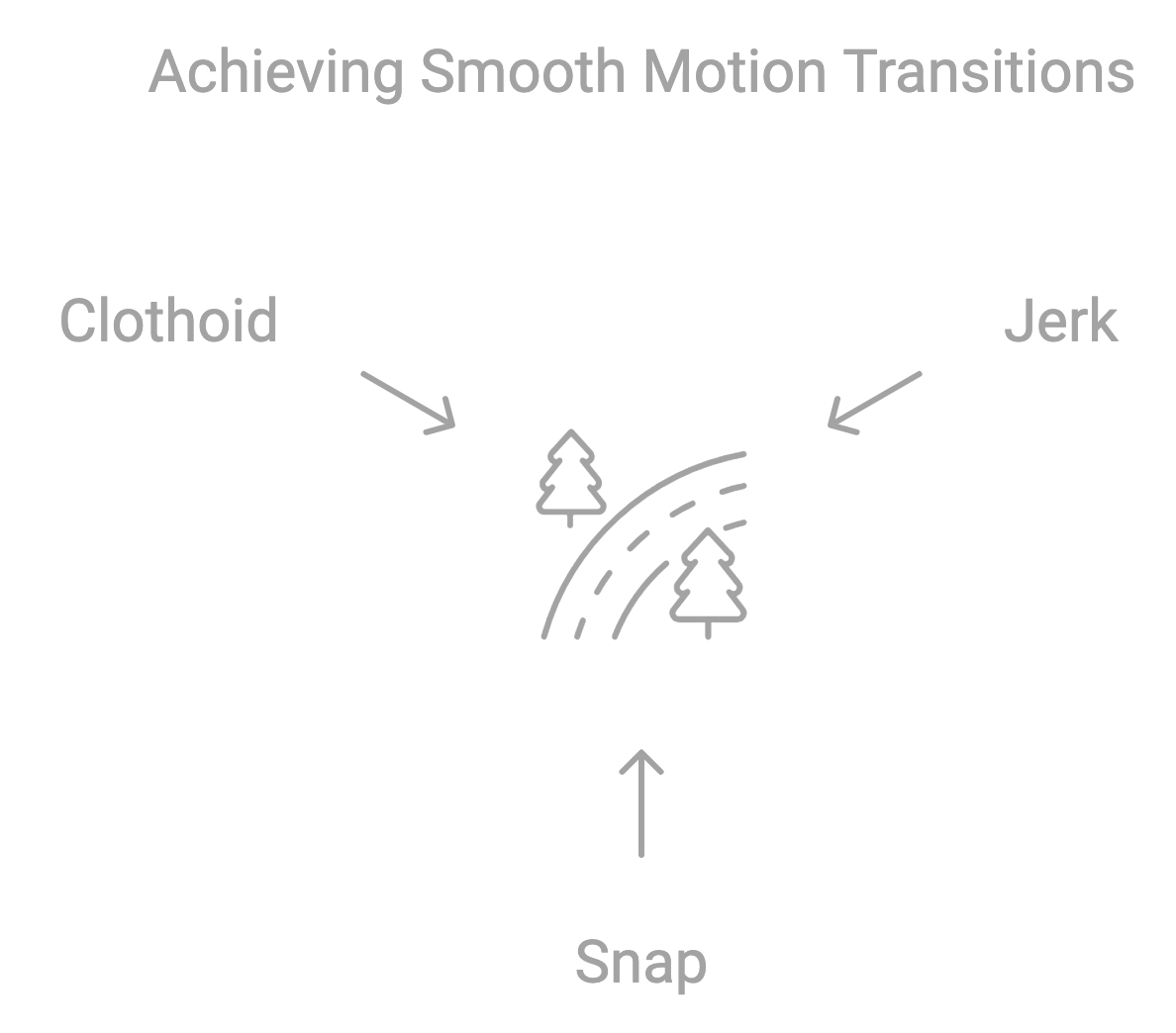
Understanding derivatives beyond acceleration is crucial in fields like engineering, where smooth transitions in motion are necessary. For instance, in civil engineering, when designing roads or railways, transitions between straight paths and curves must account for jerk and snap to avoid discomfort for passengers. A key tool in this design process is the clothoid, a spiral shape that allows for gradual changes in curvature, minimizing jerk and snap. 🛤️🛣️
Even in seemingly simple actions like driving a car, you are managing jerk every time you press the accelerator or brake pedal. A smooth transition helps avoid the sudden “jerk” that passengers feel, making the ride more comfortable. 🚗💨
A Formula 1 Insight
As a big fan of Formula 1, I often hear the term "jerk" during race commentary, especially when cars are restarting after a safety car phase. As is well known, under yellow flags and safety car conditions, cars must slow down and maintain a delta time. When it’s time to restart under green flags, the lead driver determines when to accelerate, causing a sudden "jerk" in the chain of cars behind. This concept frequently comes up in commentators' analysis, and I used to think it was more of a figurative term. Only recently did I realize that there’s an actual technical meaning behind it! 🏎️⚡
Conclusion
Rediscovering physics during my university years reminded me of the beauty in understanding and describing the complexities of motion. The study of derivatives beyond acceleration may seem abstract, but they play a critical role in how we experience the world around us, from transportation to amusement parks. 🎢 Whether it's in engineering or everyday life, the control of jerk, snap, and beyond reveals the elegance hidden within the equations of motion. 📊✨
One of the most valuable lessons I’ve learned from this discovery is that we often limit ourselves to standard models, such as uniformly accelerated motion, which is emphasized in university studies. However, real-life scenarios are much more complex. This revelation reminded me to think outside the box and not solely rely on what I already know, but instead to explore beyond conventional boundaries. 🚀